
Treating your patients with MIMRYLO™ (rusfertide)

Finding the appropriate patient for MIMRYLO

Whether used alone or in combination with CRTs, MIMRYLO may be beneficial for your patients who1,2:
- Have frequent phlebotomies
- Are impacted by low iron levels and resulting fatigue
- Are receiving hydroxyurea but need more HCT control
- Report a high symptom burden and interruptions to daily life that prevent normal activities due to treatment with phlebotomy or current therapy
A once-weekly*, subcutaneous self-injection that can fit into your patients’ lives and is individualized to their needs

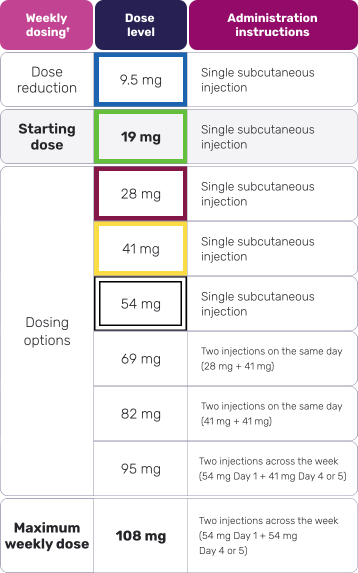
All patients initiate with 19 mg, whether using MIMRYLO alone or in combination with concomitant therapies.1

Some patients may require dose escalation based on individual efficacy and safety response.1
After two weeks, the dose can be adjusted to the next defined dosage increment. Continue to adjust dosing until the desired HCT level is reached.1
For grade ≥2 anemia or for drug-related grade ≥3 toxicities, reduce the dose of MIMRYLO to the preceding defined dosage increment.1

Once HCT control is achieved, patients should continue to take their individualized dose of MIMRYLO once a week.1
Monitor CBC every 2-4 weeks, or as clinically indicated, during dose modification1
MIMRYLO is available as a lyophilized powder for reconstitution in single-dose vials.1

After patients undergo training by a healthcare provider at first dose1:
- MIMRYLO can be self-administered at home and doses can be adjusted to help patients achieve optimal HCT stability
- If patients cannot self-administer, they can continue treatment in office
*Dosing is one injection weekly from dosage increments of 9.5 mg up to 54 mg. Weekly dosages of 69 mg or 82 mg must be administered in two injections on the same day. Weekly dosages of 95 mg or 108 mg must be administered in two injections on separate days. Please see additional details on Dosing and Administration within the full Prescribing Information.1
Flexible dosage adjustments for HCT control
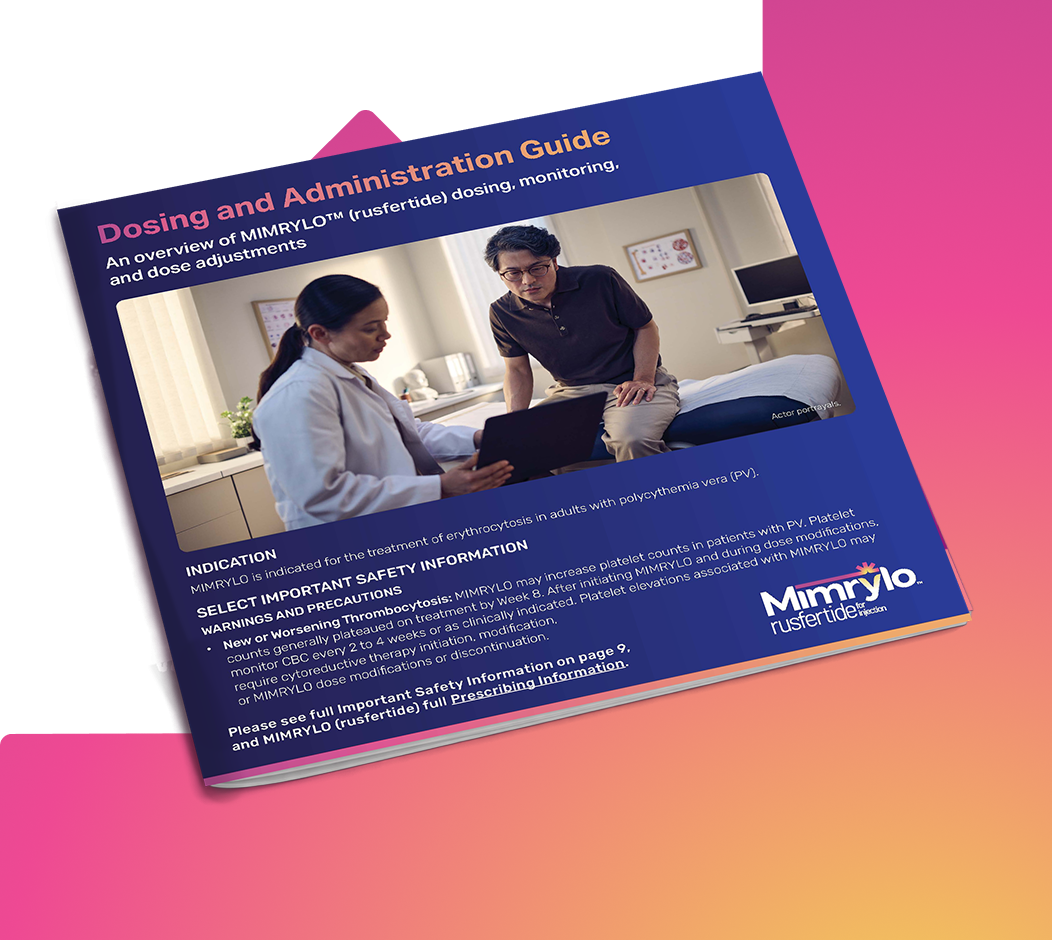
Download the Dosing & Administration Guide
Explore details on dosing, including specific guidance on dosing adjustments for efficacy and tolerability.

Start your patients off with confidence for at-home self-injections with a Welcome Kit
Our Welcome Kit will provide your patients with everything they need to get started on MIMRYLO after the first injection and administration training in office.
MIMRYLO offers your patients the flexibility to administer at home or in office if they cannot self-administer1
Watch the video and learn about dosing and administration for MIMRYLO
ShowHide Transcript
[OPENING CARD: MIMRYLO (rusfertide) for injection]
SCREEN TEXT: MIMRYLOTM - rusfertide for injection
Reconstitution and Injection
MIMRYLOTM (rusfertide) is indicated for the treatment of erythrocytosis in adults with
polycythemia vera (PV).
Please see the Important Safety Information at the end of this video, the full Prescribing
Information at MIMRYLOhcp.com/PI, and the full Instructions for Use at MIMRYLOhcp.com/IFU
[SECTION CARD: Welcome]
NURSE: Hello. Today we are reviewing the clinical administration process for MIMRYLO. While the steps for reconstitution and subcutaneous injection may be familiar, there are product-
specific nuances. Let’s get started.
[SECTION CARD: Setting up the materials]
NURSE: First, ensure patients know they should store the product at room temperature, and
never refrigerate or freeze it.
After a standard hand wash, verify the prescribed dose strength against the carton and check
the expiration date.
Lay out your components and check if the supplies are opened, damaged, or missing. In the
drug kit the patient will receive a medicine vial and a prefilled diluent syringe. Remind the patient
that they will need a needle and a vial adapter, alcohol wipes, adhesive bandages, gauze,
cotton balls, and a sharps container, which are not included in their kit. These can be picked up
from the pharmacy.
[SECTION CARD: Reconstitution and injection]
NURSE: Take off the cap from the medicine vial and clean the gray rubber stopper of the vial
with a new alcohol wipe. Don’t touch the rubber stopper after it’s clean. Then open the vial
adapter, keeping it in its packaging to maintain sterility. Place the vial on a flat surface, hold it
steady, and push the adapter straight down on the top of the medicine vial until it snaps.
Do not attach at an angle.
Remove the liquid syringe cap by turning left, then attach the syringe to the adapter by turning it
to the right until it’s snug.
Inject the liquid slowly into the vial until the syringe is empty. Slowly and gently swirl the
medicine vial in a circular motion for about 2 minutes until the powder is fully dissolved. Do not
shake.
Now that you have reconstituted MIMRYLO, inspect the solution. It should be clear with very
little foam, colorless, and free from visible particles or clumps.
Once mixed, the medication must be used within 4 hours.
To fill the syringe, make sure that the plunger rod is pressed all the way down and then invert
the vial. Then slowly pull the plunger rod to remove all of the liquid from the vial. Holding the
syringe by the body, grasp and remove the vial adapter, turning it to the left until it lifts away. Do
not touch the syringe tip or push the plunger until you are ready to inject.
Attach the needle to the syringe by turning it to the right until it is snug.
Next you will choose an injection site, usually it’s the abdomen or the front of the thighs.
Patients can also use their upper arm as a site as long as they have a caregiver to give the
injection.
Clean the area and let it air dry. Make sure you pull the needle shield back and remove air from
the syringe. Some bubbles or a small air gap may remain, which is normal. Then pinch the skin
and insert the needle at a 45- to a 90-degree angle. Inject all of the medicine slowly and don’t
rush.
[SECTION CARD: Disposal and inspection]
NURSE: Withdraw the needle at the same angle it was inserted. Immediately use a hard
surface to snap the needle shield back into place. The entire assembly goes directly into a
sharps container.
Check the site for bleeding and apply gentle pressure with a cotton ball if needed, but do not rub
the area. Document the injection site for rotation.
Efficient and accurate administration is the first step in helping your patients get started on
MIMRYLO. Thank you for your commitment to patient care.
Important Safety Information
INDICATION
MIMRYLO is indicated for the treatment of erythrocytosis in adults with polycythemia vera (PV).
IMPORTANT SAFETY INFORMATION
WARNINGS AND PRECAUTIONS
- New or Worsening Thrombocytosis: MIMRYLO may increase platelet counts in
patients with PV. Platelet counts generally plateaued on treatment by Week 8. After
initiating MIMRYLO and during dose modifications, monitor CBC every 2 to 4 weeks or
as clinically indicated. Platelet elevations associated with MIMRYLO may require
cytoreductive therapy initiation, modification, or MIMRYLO dose modifications or
discontinuation. - Injection-Site Reactions: Injection site reactions (including Grade 3 reactions) have
been reported in patients treated with MIMRYLO. The most common injection site
reactions reported were erythema, pruritus, pain, and swelling. Use ice, topical
corticosteroid creams, antihistamines or analgesics, as needed, to treat injection site
pain and swelling. - Embryo-Fetal Toxicity: Based on findings from animal reproduction studies, MIMRYLO
may cause fetal harm when administered to a pregnant woman. Advise patients to stop
taking MIMRYLO if they become pregnant.
ADVERSE REACTIONS
The most common (>15%) adverse reactions were injection site reactions (56%) and anemia
(16%).
USE IN SPECIFIC POPULATIONS
- Lactation: Because of the potential for serious adverse reactions in the breastfed child,
including impaired iron absorption, advise patients not to breastfeed during treatment
with MIMRYLO and for 30 days after the final treatment. - Females and Males of Reproductive Potential
- Pregnancy Testing: Prior to initiating MIMRYLO, pregnancy testing is
recommended for females of reproductive potential. - Contraception: Advise female patients of reproductive potential to use effective
contraception during treatment with MIMRYLO and for at least 30 days after the
final dose of MIMRYLO.
- Pregnancy Testing: Prior to initiating MIMRYLO, pregnancy testing is
To report SUSPECTED ADVERSE REACTIONS, contact Takeda Pharmaceuticals at 1-844-
662-8532 or the FDA at 1-800-FDA-1088 or www.fda.gov/medwatch.
Please see MIMRYLO (rusfertide) full Prescribing Information at MIMRYLOhcp.com.
END SCRIPT